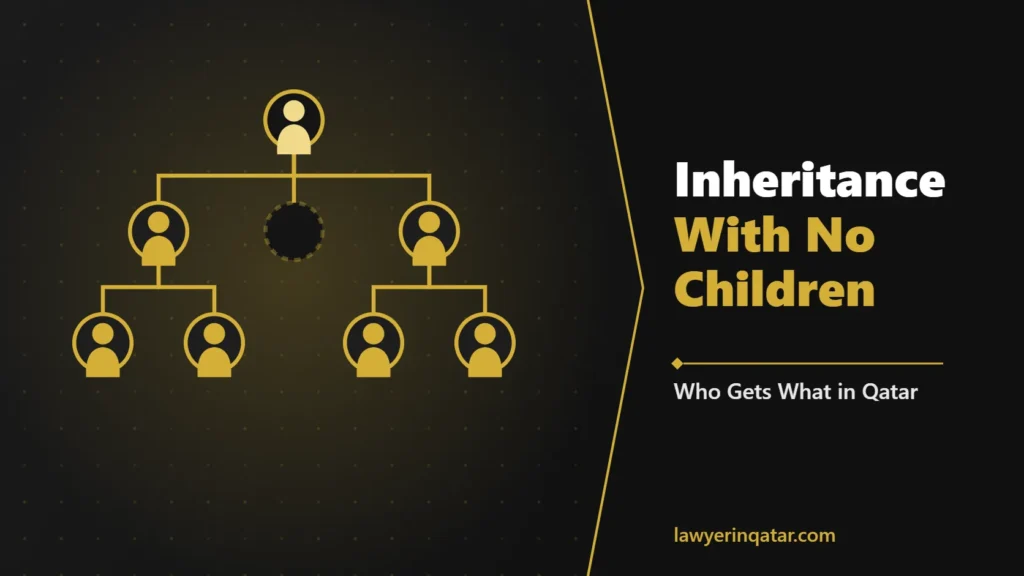
Inheritance in Qatar with no children — when the deceased leaves no son or daughter — is not simply “everything goes to the siblings”. Under the inheritance provisions of the Family Law (Law No. 22 of 2006), you must first identify all heirs, check whether there is any descendant further down (such as a son’s child), give the fixed shares to the spouse and parents, and only then pass the remainder to the nearest residuary heir — which may be the father, a full brother or a nephew. The father, if alive, excludes the siblings.
This guide explains what the spouse, parents, siblings and nephews receive, with worked examples. If the deceased was not Qatari, check first which law applies (Article 24 of the Civil Code).
Dividing the estate of a relative who had no children? The office of lawyer Fatima Thani Al-Maadeed reviews the family tree, calculates the shares and exclusions and prepares the division before any money is distributed.
Order of Calculation
Heirs’ shares are calculated in a fixed order:
- Pay funeral costs and debts, and carry out any valid will within its legal limits.
- List all heirs alive at the time of death.
- Give the spouse’s share.
- Give the parents’ shares, or apply the grandfather rules if the father is not alive.
- Check the siblings and their type (full, paternal, maternal).
- Pass any remainder to the nearest residuary heir, including nephews if no nearer residuary exists.
The Spouse’s Share
The surviving spouse’s share depends on whether the deceased left an inheriting descendant:
- Wife: one quarter if the husband left no inheriting descendant; one eighth if he did, even from another wife. Several wives share equally.
- Husband: one half of his wife’s estate if she left no inheriting descendant.
The marriage must be valid and in force at the time of death; a divorced wife’s position depends on the type of divorce and whether death occurred during the waiting period (Articles 253–255).
The spouse is usually the first heir to consider in inheritance in Qatar with no children.
Following this order is the safest way to work out inheritance in Qatar with no children.
The Parents’ Shares
Father (Article 257)
With no inheriting descendant, the father takes the remainder after the fixed shares as a residuary heir. He excludes full and paternal siblings and nephews, even if the deceased had no children.
Parents often take the largest part in inheritance in Qatar with no children.
Mother (Article 258)
The mother’s share changes with the other heirs present:
- One sixth if there is an inheriting descendant or two or more siblings.
- One third if there is no inheriting descendant and no group of siblings.
- One third of the remainder after a spouse’s share when she inherits with the father and one spouse.
Note that two or more siblings reduce the mother to one sixth even when the father excludes them from inheriting.
The paternal grandfather
If the father has died and the paternal grandfather inherits with siblings, he does not automatically exclude them. The Family Law sets special rules for this combination, so it needs a separate calculation.
When Do Siblings Inherit?
Full brother
A full brother is a residuary heir in his own right with no fixed share. He takes the whole estate if there is no fixed-share heir or nearer residuary, or the remainder after the fixed shares. He makes a full sister residuary with him (a male twice a female) and takes priority over a paternal brother. In the special “shared” case of Article 260, full siblings share the one third with maternal siblings.
Siblings come into inheritance in Qatar with no children only when no nearer heir excludes them.
Full sister
With a full brother she inherits as his co-residuary. Without one, she may inherit a fixed share depending on the number of sisters and the other heirs, or become residuary with female descendants in the cases the law sets.
Maternal siblings (Article 259)
One maternal sibling takes one sixth; two or more share one third equally (males and females alike), provided there is no inheriting descendant or male ascendant.
When Do Nephews Inherit?
If there is no descendant, no father or entitled grandfather, and no full or paternal brother, the estate passes to more distant residuaries. Articles 270 to 272 list sons of full and paternal brothers as residuaries in their own right and rank residuaries by line, then degree, then strength of kinship. A brother’s son inherits the remainder (or everything, if alone) when:
Nephews are among the more distant heirs in inheritance in Qatar with no children.
- there is no male descendant, father or nearer residuary;
- there is no full or paternal brother, or a nephew of a nearer degree;
- at the same degree, a full brother’s son takes priority over a paternal brother’s son.
A brother’s daughter does not share with him on a two-to-one basis: she is not made residuary by him, and her position is examined under the rules for distant kin (dhawu al-arham).
Quick Reference Table: Inheritance in Qatar With No Children
The table below shows the most common cases where the deceased left no children:
| Heirs | Distribution | Key condition |
|---|---|---|
| Wife + father + mother | Wife 1/4; mother 1/3 of the remainder; father the rest | No descendants and no group of siblings |
| Husband + father + mother | Husband 1/2; mother 1/3 of the remainder; father the rest | No descendants and no group of siblings |
| Father + mother + two or more siblings | Mother 1/6; father the rest; siblings excluded by the father | “Group” means two or more siblings |
| Full siblings only | Shared as residuaries, a male twice a female | No nearer residuary; maternal siblings follow different rules |
| One full brother’s son only | Takes the whole estate as residuary | No fixed-share heir or nearer residuary |
This table is illustrative; adding another heir can change the whole calculation.
Worked Examples (Net Estate QAR 120,000)
Wife, mother and one full brother
In this case the estate is divided as follows:
- Wife: 1/4 = QAR 30,000.
- Mother: 1/3 = QAR 40,000 (one brother is not a “group”).
- Full brother: remainder = QAR 50,000.
Husband, father and mother
Here the shares are calculated as follows:
- Husband: 1/2 = QAR 60,000.
- Mother: 1/3 of the remainder = QAR 20,000.
- Father: remainder = QAR 40,000.
One full brother and one full sister only
The brother and sister share the estate as residuaries:
- Brother: QAR 80,000.
- Sister: QAR 40,000.
One full brother’s son only
He takes the whole estate as the nearest residuary heir.
Special Situations
Some situations can change the calculation:
- Wills: carried out after debts and before division, within the legal limits; a will to an heir follows different rules and may need the other heirs’ consent.
- A minor heir: the share is fixed like any other, but its management is subject to guardianship and court supervision.
- Non-Qatari deceased: Article 24 of the Civil Code links inheritance to the deceased’s nationality at death.
Avoiding Inheritance Disputes
These practical steps help heirs avoid disputes:
- Obtain the official document establishing the heirs.
- List all property, accounts, shares, debts and rights.
- Pay the rights that come before inheritance (Article 242).
- Check the will’s validity.
- Prepare a formal inheritance calculation and document any agreed division, protecting any minor’s share.
- Go to court if the heirs cannot agree.
Heirs disagree about the shares or the division? We establish the heirs, calculate the shares and exclusions, review debts and wills and represent heirs in inheritance disputes.
These situations can change any calculation of inheritance in Qatar with no children.
Frequently Asked Questions
How is an estate divided in Qatar when the deceased has no children?
After funeral costs, debts and any valid will are settled, the estate goes first to the fixed-share heirs (spouse and parents), and the remainder to the nearest residuary heir. Siblings do not inherit automatically: the father excludes them.
What does a wife inherit if her husband has no children?
One quarter of the estate. If the husband had a child or grandchild through a son — even from another wife — she inherits one eighth. Several wives share the quarter or eighth equally.
What does a husband inherit if his wife has no children?
One half of her estate.
How much does the mother inherit if there are no children?
One third, unless there are two or more siblings (then one sixth). If the mother inherits with the father and one spouse, she takes one third of what remains after the spouse's share (Article 258).
Does the grandfather exclude the full brother in Qatar?
Not always. The Family Law has special rules when the paternal grandfather inherits with siblings, so the case must be calculated on its own facts.
Does a nephew's sister share with him?
No. A brother's son is a residuary heir in his own right, but a brother's daughter does not become residuary through him, so they do not share on a two-to-one basis.
Which law applies if the deceased was not Qatari?
Under Article 24 of the Civil Code, inheritance is in principle governed by the law of the deceased's nationality at the time of death, so this must be checked first.
When someone dies without children, the shares depend on exactly who survives them. Contact the office of lawyer Fatima Thani Al-Maadeed to have the heirs and shares reviewed before division.
Legal notice: This information is for general guidance only and is not legal advice. For advice on your specific case, please consult a qualified lawyer.
Official Sources
The legal information in this article is based on the following official sources:
- Family Law No. 22 of 2006, inheritance provisions (Articles 241–301) – Al Meezan
- Civil Code No. 22 of 2004, Article 24 – Al Meezan
Source: Al Meezan, the Qatar Legal Portal of the Ministry of Justice. Sources last reviewed: 26 November 2026.
Fatima Thani Al-Maadeed is a leading lawyer admitted before the Court of Cassation in Qatar, with extensive experience in Qatari law. She began her legal career with a firm belief that the law is the essential tool for achieving justice and protecting rights. Her ambitious vision led her to found a law office in Doha in 2011, to be a true partner to clients at every step of their legal journey.
Her practical and advisory experience has built an advanced understanding of procedures and regulations, which is reflected in how she manages cases and provides clear, well-considered legal advice that meets her clients’ needs and protects their rights to the highest professional standards.