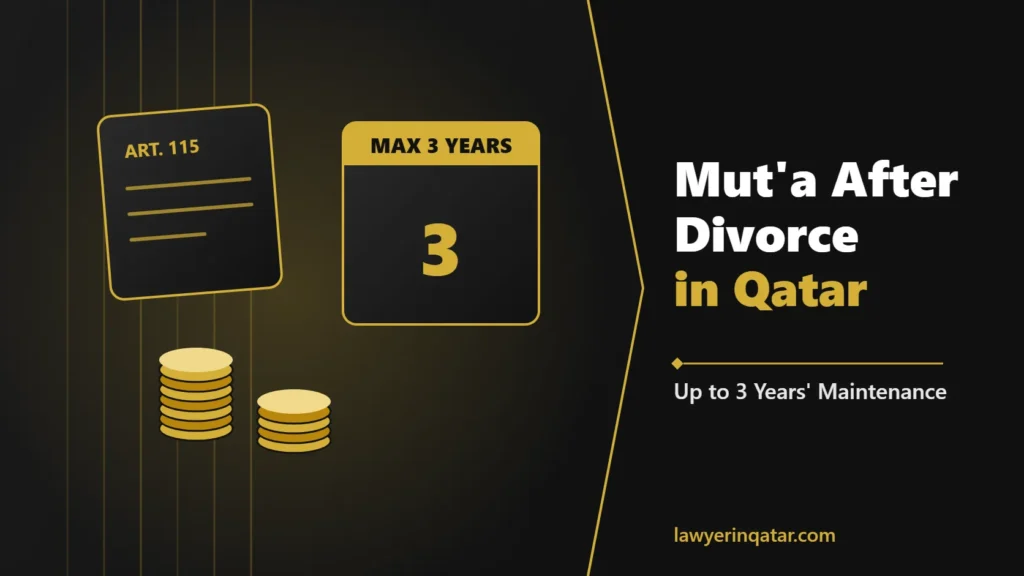
Mut’a, the main form of divorce compensation in Qatar, is a one-off payment the husband pays his divorced wife for the divorce itself. Under Article 115 of the Family Law (Law No. 22 of 2006), every divorced woman is entitled to mut’a if the divorce was caused by the husband. The court sets the amount according to the husband’s means and the wife’s circumstances, and it cannot exceed three years’ maintenance.
We checked Articles 39, 41 and 115 of the Family Law on the Al Meezan legal portal on 27 November 2026.
Divorced unexpectedly and worried about your financial rights? The office of lawyer Fatima Thani Al-Maadeed files mut’a and maintenance claims at the Family Court and proves your entitlement and the husband’s means.
Divorce Compensation in Qatar at a Glance
The table below summarises the key rules on mut’a under the Family Law:
| Question | Answer | Article |
|---|---|---|
| Who is entitled? | Every divorced woman whose divorce was caused by the husband | 115 |
| Exception | Separation for non-payment of maintenance because the husband is insolvent | 115 |
| How is it assessed? | By the husband’s means and the wife’s circumstances | 115 |
| Maximum | Three years’ maintenance | 115 |
| Divorce before consummation, no dowry named | Mut’a of up to half the standard dowry | 39 |
| Separation before consummation caused by the wife | Mut’a (and the dowry) lapse | 41 |
What Is Mut’a?
Mut’a is not maintenance for daily needs. It is a sum paid once to compensate the wife for the divorce and the loss of married life. It is not paid automatically: the wife claims it before the Family Court, which decides whether she is entitled and how much.
Divorce compensation in Qatar is therefore different from the maintenance a wife receives during the waiting period.
Who Is Entitled to Mut’a in Qatar?
A divorced wife is entitled to mut’a when the following conditions are met:
- The divorce was caused by the husband.
- The divorce was not caused by the wife — for example, it is not khula, where the wife pays compensation to end the marriage.
- The separation was not ordered for non-payment of maintenance due to the husband’s insolvency, which Article 115 expressly excludes.
- If the separation happened before consummation or valid seclusion for a reason on the wife’s side, mut’a lapses (Article 41).
How Is Mut’a Calculated?
The law does not fix an amount but gives the court two criteria and a ceiling:
If none of these exceptions applies, the court can award divorce compensation in Qatar on the wife’s claim.
- the husband’s financial means;
- the wife’s circumstances;
- a maximum of three years’ maintenance.
Within that limit, the court weighs the evidence of the husband’s income, both parties’ circumstances and the length of the marriage. Mut’a is a lump sum, unlike waiting-period maintenance or child maintenance, which are periodic.
Mut’a vs Maintenance
Mut’a is often confused with maintenance, but the two differ as follows:
| Mut’a | Maintenance |
|---|---|
| Compensation for the divorce itself | Covers food, clothing, housing and medical care |
| Paid once after the divorce | Paid during the marriage or the waiting period |
| Capped at three years’ maintenance | Assessed according to the husband’s means and needs |
Separating the two claims matters, so each is proved on its own basis.
Divorce Before Consummation
Under Article 39, a woman divorced before consummation is entitled to half of the named dowry. If no dowry was named, or the naming was invalid, the judge awards her mut’a of no more than half of the standard dowry for a woman like her.
How to Claim Mut’a
A mut’a claim is usually prepared in these steps:
- Make sure the divorce is registered or proved before the Family Court.
- Gather evidence of the husband’s income and financial position.
- File the mut’a claim, together with any maintenance or children’s claims.
- Show that the divorce was caused by the husband and that no exception applies.
Want to claim your full post-divorce rights? Our family lawyers prepare your mut’a and maintenance claims and represent you before the Family Court.
Frequently Asked Questions
What is mut'a (divorce compensation) in Qatar?
Mut'a is a one-off compensation paid to a divorced wife for the divorce itself. Under Article 115 of the Family Law, every divorced woman is entitled to it if the divorce was caused by the husband.
How much is mut'a in Qatar?
The law sets no fixed amount. The court assesses it according to the husband's financial means and the wife's circumstances, up to a maximum of three years' maintenance (Article 115).
When is a divorced wife not entitled to mut'a?
If the divorce was caused by the wife (for example khula, where she pays compensation), if the separation was ordered for non-payment of maintenance because the husband is insolvent, or if the separation happened before consummation for a reason on the wife's side (Articles 41 and 115).
Is mut'a the same as maintenance?
No. Maintenance covers living needs during the marriage or the waiting period, while mut'a compensates for the divorce itself and is paid once.
Does a woman divorced before consummation get mut'a?
If no dowry was named or the naming was invalid, the judge awards her mut'a of no more than half of the standard dowry (Article 39). If a dowry was named, she is entitled to half of it.
Do I need children to claim mut'a?
No. Mut'a is the wife's right as a divorced woman; child maintenance is a separate claim.
Mut’a protects a divorced wife’s dignity and financial stability, but it must be claimed and proved. Contact the office of lawyer Fatima Thani Al-Maadeed for advice on your case.
Legal notice: This information is for general guidance only and is not legal advice. For advice on your specific case, please consult a qualified lawyer.
You may also want to read: how to file for divorce in Qatar and khula in Qatar.
Official Sources
The legal information in this article is based on the following official sources:
Source: Al Meezan, the Qatar Legal Portal of the Ministry of Justice. Sources last reviewed: 26 November 2026.
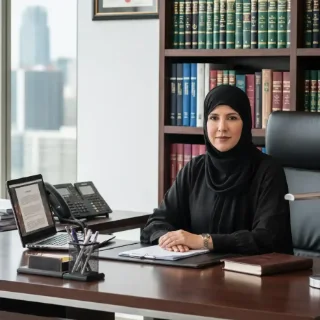
Fatima Thani Al-Maadeed is a leading lawyer admitted before the Court of Cassation in Qatar, with extensive experience in Qatari law. She began her legal career with a firm belief that the law is the essential tool for achieving justice and protecting rights. Her ambitious vision led her to found a law office in Doha in 2011, to be a true partner to clients at every step of their legal journey.
Her practical and advisory experience has built an advanced understanding of procedures and regulations, which is reflected in how she manages cases and provides clear, well-considered legal advice that meets her clients’ needs and protects their rights to the highest professional standards.